Tuesday, August 31, 2010

March, my birthday, and I'm still here!

Hi Readers! I am still here responding to people's requests for homework help, I just don't post the answers on my blog as much anymore. But rest assured, I am still here answering your emails.

Also, to celebrate my birthday this week, I invite you to partake in this fun online gaming experience called "Auditorium"!

http://www.playauditorium.com/

I enjoyed it so much that I played it all the way through on my first sitting!


math homework help for free

The Oregon Carbon Calculator

My carbon footprint.

Rudy Berg of the SW Oregon chapter of the Northwest Eco-Building Guild regularly keeps many of us here in Eugene informed of events, articles, or links of interest on the subject of living and designing sustainably. One of his recent e-mail blasts introduced me to the Oregon Carbon Calculator.

The Oregon Carbon Calculator is a new interactive tool on the DEQ website that lets Oregon residents measure their carbon footprint and discover ways to improve it. The tool calculates all direct and indirect greenhouse gas emissions from personal transportation, household energy use, and consumption of food, goods and services.

It’s fun and easy to use. You’ll find out how your household's carbon footprint compares to households of similar size and income here in Oregon. You’ll also learn how you can take action to reduce your carbon footprint from a number of specific ideas and strategies.

I calculated that the total carbon footprint for me and my wife is 75% of comparable households in the state. Good for us. However, it’s still 380% of the global average. The per person resource demand in this country is about 8.5 hectares versus the world average of about 2.2 hectares. We’re running an ecological deficit, with a footprint larger than our biological capacity.

There are numerous other online tools (such as Carbon Footprint) for assessing the size of one’s carbon footprint but I had not previously sought them out. Thanks, Rudy, for informing me about the Oregon Carbon Calculator.

The Oregon Carbon Calculator is made possible through Oregon DEQ's support of the CoolClimate Network, a program of the University of California, Berkeley, and through financial support by the California Air Resources Board and the CoolCalifornia.org partnership. Oregon DEQ selected this calculator for its approach and depth in calculating human impacts to climate change.

how many hours until calculator

Cereal Box Generator.

Upload an image from your computer. (Width must be less then 150 pixels. Height needs to be less than 250 pixels. Upload only images that end in: .jpg) When you're satisified with your work, you can print out your box. To create the box, you'll just need to cut away the grey area and fold in the tabs.


(thanks Ruth)

[ Cereal Box Generator ]

box plot generator

Online Algebra Tutor

Algebra Help
Internet has changed the way we learn and communicate. Want to learn more about a topic? Just do some searches or take help from specialized sites on that particular topic. Want to continue your study, but don't have time to attend classes? Just enroll for an online course and get your degree from the comfort of your own home.

Similarly, want to help your kids complete their homework assignments on time? Just contact a good online tutoring service and the rest will be taken care of by the online tutors. It will give you complete peace of mind. How? Imagine a situation where your child needs some help with Algebra and you are unable to ! find any good tutor. What you gonna do? Continue your search or simply get an online tutor. Your Online algebra tutor will not only help your child with their homework or assignments, but will also help your child understand major concepts of Algebra.

Nowadays, there are many online tutoring services that promises to take care of your child's study. But all are not same. Some may provide excellent service, while some may just want to take your money. So, take care while choosing an online tutor for your kids. Consult with others and go with the most reliable one.

Looking for a reliable online tutoring service? Let's return to your case. Want Algebra help for your child? Try TutorVista, an education services company that provide online tutoring to needful for K-12 and college students around the world. Their service covers many subjects and tutoring! is done in an one-on-one secure web environment by using the ! latest t echnologies. So, all you need to have is a computer with a broadband connection. Their unique virtual whiteboard works much like a traditional blackboard, where both student and tutor can write to share problems and answers. Even your child can chat with the Algebra tutor by using their instant messaging service.

What about the charges? Their monthly unlimited online tutoring package will cost you $99.99. In my view, this is a reasonable price. Because, TutorVista's online tutoring service is available 24-hours a day, 7 days a week and there is no limit for maximum number of tutoring sessions. You can connect to the tutor, whenever and wherever your child needs help. If you want, you can also try their free demo.

So, get an online algebra tutor today and see your child excel in school. I am sure that you won't regret!


algebra tutoring online

Printable TAKS Tests Math Reading, Science, Social Studies All Grades

All years, all grades, both English and Spanish, with answer keys.

Solving two step equations activities

Gauss: Construction of regular polygons

It was not enough for Carl Friedrich Gauss to prove the constructibility a heptadecagon (a seventeen sided polygon). He generalized the idea to come up with the theorem that I will present today.

The content in today's blog is taken from Jean-Pierre Tignol's Galois' Theory of Algebraic Equations.

Lemma 1: The periods of two terms are (2 cos 2kπ/p) for k = 1 ... (p-1)/2

Proof:

(1) ηj = ζj + ζ[j + (p-1)/2] [See Definition 3, here where e = (p-1)/2 and f = 2]

(2) ζ[j + (p-1)/2] = (ζj)g(p-1)/2 [See Definition 1, here]

(3) g(p-1)/2 ≡ -1 (mod p) since:

(a) (g(p-1)/2)2 ≡ gp-1 (mod p)

(b) gp-1 ≡ 1 (mod p) [By Fermat's Little Theorem, see here]

(c) Thus, g(p-1)/2 ≡ ± 1 (mod p)

(d) But since g is a primitive root modulo p (see D! efinition 2 and Definition 4, here) and since (p-1)/2 is less than p-1, it follows that g(p-1)/2 ≠ 1.

(e) Thus, we have that g(p-1)/2 ≡ -1 (mod p).

(4) So, we have ηj = ζj + ζj-1 [See Lemma 1, here]

(5) We can expre! ss the p-th roots of unity as solutions to Φp(x) such that they are the solution to:

xp-1 + xp-2 + ... + 1 = 0 [See Lemma 1, here]

(6) The trigonometric solution for the equation above are (see Corollary 1.1, here):

cos 2kÏ€/p + isin 2kÏ€/p where 1 ≤ k ≤ p-1.

(7) For ζj, there exists an integer m such that:

ζj = cos 2mπ/p + i sin 2mπ/p

(8) Using Lemma 4, here, where u= 2mπ/p, we have:

ζj + ζj-1 = cos 2mπ/p + i sin 2mπ/p + cos 2mπ/p - isin 2mπ/p = 2 cos 2m π/p.

QED

Theorem 2: If p is a prime number of the form p = 2m+1 (with m ∈ N) then the regular polygon with p sides can be constructed with ruler and compass.

Proof:

(1) Since p=2m + 1, p-1 is a power of 2.

(2) We can thus view p-1 as a chain of multiplications such as:

1 → 2 → ... → 2m-2 → 2m-1 → 2m

(3) Using a previous result (see Lemma 5, here), we can see that the chain of multiplication in step #2 shows that the periods of two terms can be determined by solving a sequence of quadratic equations.

(4) The periods of two terms are the values 2 cos 2kπ/p for k = 1 ... (p-1)/2 [See Lemma 1 above]
(5) Since the solution of a quadratic equation only requires rational operations and extraction of square roots (see Theorem, here), it follows that cos 2Ï€/p can be obtained from 0 and 1 by rational operations and extractions of roots.

(6) So, using Wantzel's Constructibility Criterion (see Theorem 5, here), it follows that (cos 2Ï€/p, 0) is constructible.

(7) Let A be a point at (0,a) and O at (0,0) such that we take OA as one unit of measurement and circle OA
is a unit circle (see here for details if needed on unit circles)

(8) Point P0 = (cos 2Ï€/p, sin 2Ï€/p) is obtained in the following way:

(a) Let Q be the point at (cos 2Ï€/p, 0) that we showed was constructible in step #6 above.

(b) Let QP0 be a line that is perpendicular to OQ and where P0 intersects with the unit circle OA. [See here for Euclid, Book I, Proposition 11 whic! h shows this construction]

(c) Now, we can see that P0 is at (cos 2Ï€/p, sin 2Ï€/p) since:


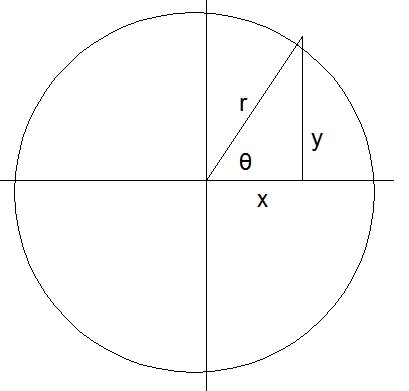
By the diagram above:

x = cos 2Ï€/p

r = 1

Since cos θ = (cos 2π/p)/1 = cos 2π/p, we have θ = 2π/p.

Also, we have: sin θ = sin 2π/p = y/1 ! = y

(9) The point P0 is a vertex of the regular polygon with p sides. The line AP0 forms one side of the polygon, so we can label point A as P1.

(10) We can find the other p-1 sides in the following way. Let P0P1 be a circle at point P1 with radius equal to P0P1 (see Postulate 2, here). Call P2 the point where circle P0P1 intersects with unit circle OA (and is not point P0). We can repeat for circle P2P1 (finding point P3), circle P3P2 (find point P4), etc. until we have constructed our regular p-sided figure.

QED

Corollary 2.1: A regular polygon with n sides can be constructed with a ruler and compass if n is a product of distinct Fermat primes and a power of 2.

Proof:

(1) A regular polygon with n sides is constructible when n is a Fermat prime. [By Theorem 2 above]

(2) Since we can always do a repeated bisection of angles (see here for Euclid's Elements, Book I, Prop 9), a regular polygon with n sides is also constr! uctible when n is a po! wer of < span style="font-weight: bold;">2
.

(3) So, to complete this proof, we only need to show that if n1 and n2 are relatively prime and a polygon with n1 sides is constructible and a polygon with n2 sides is constructible, then it follows that a polygon with n1n2 sides is constructible.

(4) Since n1, n2 are relatively prime, there exists! integers m1, m2 such that (see Lemma 1, here):

m1n1 + m2n2 = 1.

(5) Multiplying both sides by 2Ï€/(n1n2) gets us:

m1(2Ï€/n< /span>2) + m2(2Ï€/n1) = 2Ï€/(n1n2)

(6) Therefore using Wantzel's Criterion (see Theorem 5, here), it follows that 2Ï€/(n1n2) can be constructed by repeating a certain number of times 2Ï€/n1 and 2Ï€/n2.

(7) It therefore follows that the regular polygon with n1n2 sides can be constructed from regular n1 polygon and a regular n2 polygon.

QED

References

regular polygon angles

Differences between Determinants and Matrices

Determinants and matrices, they look alike. Their similarities caught many unaware and results in "excitements" and much interests.

Both contain numbers within. But ......

- determinants are bounded by two straights lines whereas matrices are by square braces

- determinant resulted in a single numerical value, whereas matrices are sets of numbers grouped within the braces

- determinant can be extracted from matrix, but not the other way round

- there are inverse matrix but not inverse determinant

- a scalar multiplier affects only a single row or single column of a determinant, but affects all the numbers within a matrix

The differences are aplenty. But those listed above are the least any maths students or person should know.

Why create such topics to excite maths learners?
Answer: So that maths will be made interesting and challenging (... the informal reply)

With open m! indedness, maths is a very fantastic subject to learn and train for. It carries many hard works and beautiful thinking. Thoughts that are simple yet abstract at times.

Any more fun? ..... You are the answer!

.

determinants of matrices