Tuesday, August 31, 2010

Stock Chart Pattern - Cranes Software (An Update)

The stock chart pattern of Cranes Software brings to mind a few stock market cliches:

1. Never try to catch a falling knife - you are supposed to wait for the knife to hit the table first, where it is likely to vibrate for a while; then it is safer to catch it. Question is: do you want to? (In the case of Cranes Software, some one seems to have removed the table which was covering a bottomless hole!)

2. Just because a stock is trading cheap, doesn't mean it can't trade cheaper.

3. Never average down in price; average up instead, because you don't know how low it can go.

The bar chart pattern of the Cranes Software stock from Mar '09 till date shows that ambition and the pursuit of growth needs to be tempered with financial prudence and patience - otherwise it may lead to annihilation:-

CranesSoft_May0510

When I wrote about the stock back in July '09, it had made a double-bottom - 35 in Mar '09 and 34 in Jul '09 - and tried to move up. The resistance from the 50 day EMA proved too strong and the stock moved down again to 33.5 in Aug '09.

An up move on good volumes took the stock above the 50 day EMA, but a double-top at 48 proved to be its last hurrah. The stock dropped below the 50 day EMA in Oct '09 and has stayed below it till date.

A long-term support-resistance line has been drawn at 33. That level supported the stock's fall four times (marked by up arrows). This provides a cla! ssic example about support-resistance levels - which act more ! like a t hin membrane than a spring. Each test of the support (or resistance) weakens it.

After three or four tests, the support (or resistance) tends to break. Thereafter, the support usually turns into a resistance, and a resistance turns into a support. Note that after the convincing break below the support of 33 in Dec '09, the level provided resistance in Jan '10 (marked by the down arrow), and then the bottom fell out of the stock.

The MACD has remained negative since Oct '09. The RSI and slow stochastic have once again entered oversold zones.

For those who did not read my earlier analysis in July '09, the concluding paragraph is quoted below:

"The stock chart pattern of Cranes Software is a reminder of what can happen if the pursuit of growth by acquisition leads to too much debt. Even good cash flows from operations may not be enough to survive. This is not for the faint-of-heart. Intrepid investors should maintain strict stop loss at! Rs 33."

Technical analysis is not perfect. But if you don't know the basics, it can hurt you where it hurts the most in the stock market. Your wallet!

Bottomline? The stock chart pattern of Cranes Software shows that its glory days during the previous bull market are long gone, and now it is just a struggle for survival. If you own the stock, get out now. If you think it can't go lower, think again. It is game, set and match for the bears.

(Question for readers: what do you think the volume action may indicate?)

Related Post

About Support and Resistance levels in stock chart patterns

times table chart up to 100

Distance formula - Part II

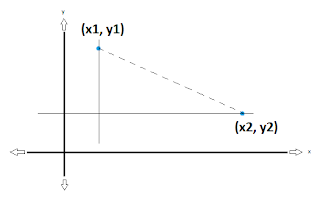
Continuing from my last post, where I told you that the distance between two points can be determined by finding the length of the hypotenuse of the right angle triangle formed from the two points.

We already know that to find the length of the hypotenuse, we apply the Theorem of Pythagoras, which says that c^2 = a^2 + b^2. (The square of the hypotenuse is equal to the sum of the squares of the remaining two sides). So from this, then, we see that we need to determine the lengths of the two sides that we have created by extending lines through our points to join at a right angle. And to find these lengths, all we need to know are the coordinates of our ! 2 points!

For a general triangle, then, we have something like this:
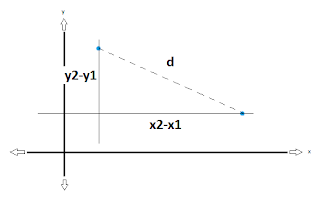
To find the horizontal length, it is just the difference between the two x-coordinates (ie. x2-x1). Think of it as taking a stick that is x2 units long, and chopping off a length of that stick that is x1 units long. The stick that you are left with, x2-x1, is the length of our horizontal side.

The same reasoning applies to find the vertical length, which is the difference between the two y-coordinates (ie. y2-y1). One comment I will make here, is that since we are talking ab! out a length of a side, the length has to be the absolute diff! erence b etween the two points (ie. you can't have a negative side length).

So then, for our general triangle, we have our 2 lengths, and let's call the hypotenuse "d" (as in, the distance between the two points).
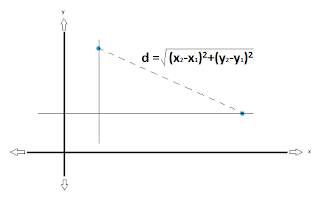
So then, if we apply the Theorem of Pythagoras to this triangle we have created, we can come up with the distance formula very easily!

c^2 = a^2 + b^2...... which we can change to read:
d^2 = (x2-x1)^2 + (y2-y1)^2

And so we have:

d = sqrt [(x2-x1)^2 + (y2-y1)^2]
Let's quickly try with 2 points. You can draw the triangle out as I have above to follow along more closely. I will just do the quick calculation for you though.

Find the distance between the points (1,2) and (3,5).

d = sqrt [(3-1)^2 + (5-2)^2]
d = sqrt [(2)^2 + (3)^2]
d = sqrt [4 + 9]
d = sqrt [13]
And that's all there is to it. I hope that I've been able to clearly explain how to derive the distance formula. Once you know where a lot of these formulas come from, you'll never have to worry about memorizing them again! :)

solve help math

Oliver Crisp's Attempt to Defend Penal Substitution

Oliver Crisp is a Professor of Theology at the Univeristy of Bristol. He is a prolific young author who has written extensively on Philosophical Theology (Philosophical theology is the disciplined employment of philosophical methods in developing or analyzing theological concepts). This approach to Theology attempts to "make sense" of Christian doctrines. In other words, it attemp! ts to provide a rational understanding and philosophical explanation of how the doctrines cohere. Alvin Plantinga defines Philosophical Theology as a matter of thinking about central doctrines of the Christian faith from a philosophical perspective; it is a matter of employing the resources of philosophy to deepen our grasp and understanding of them ("Christian Philosophy at the End of the Twentieth Century," in James F. Sennett, ed. The Analytic Theist, An Alvin Plantinga Reader [1998], p. 340).

There have been a few attempts by contemporary philosophical theologians to explain how the Penal Substitutionary Theory (PST) of the atonement works: John Hare, Steven Porter (see here, here, and here), and Oliver Crisp. I have dealt with Hare's explanation in a previous post and I have a paper on Steven Porter's theory which I have submitted for publication in an academic journal. In this post I would like to examine Oliver Crisp's attempt to defend the PST.

In Chapter 19 of The Oxford Handbook of Philosophical Theology (eds. Thomas Flint and Michael Rea [2009], pp. 430-51), Crisp has an article entitled: "Original Sin and Atonement."

He begins the article by admitting that to this point, no one has really been able to explain how the atonement of Christ works:
The atonement is one of the central and defining doctrines of Christian theology. Yet the nature of the atonement--how it is that Christ's life and death on the cross actually atone for human sin--remains a theological conundrum (p. 430).

He continues:

In the theological literature, the relation between Christ's penal substitution for the sinner and the sinner's sin and/or guilt is usually (though not always) made sense according to what I shall call a "forensic fiction." God treats Christ as if he is guilty of the sin of fallen human beings, and "punishes" him accordingly . . . on this forensic fiction account of penal substitution, the innocent Christ really is treated as if he were the guilty sinner, though he is not. And God really does punish the innocent in the place of the guilty (p. 436).

He admits that this appears to be unjust. He states:

[W]e find no examples of legislation allowing substitution when the crime is a serious felony, such as murder. In such cases, the one guilty must meet the penal consequences of that crime, and we would consider it a terrible miscarriage of justice were a substitute punished in place of the perpetrator (p. 436).

What the defender of the theological application of penal substitution needs is some reason for thinking that it is just for God to punish Christ in place of the sinner. . . For, whatever else the defender of penal substitution says, unlike pecuniary penal substitution, it certainly looks unjust that Christ, an innocent individual, should be punished in place of me, a sinful individual (p. 437)

This injustice Crisp attempts to solve through what he terms: Realist Penal Substitution. He draws the term from the Realist theory of the imputation of sin which goes back to Augustine. Augustine taught that in a real sense every human being was present in Adam when he sinned.  He phrased it this way: In the first man, therefore, there existed the whole human nature, which was to be transmitted by the woman to posterity, when that conjugal union received the divine sentence of its own condemnation; and what man was made, not when created, but when he sinned and was punished, this he propagated, so far as the origin of sin and death are concerned(City of God, 13:3). According to Augustine, we were all present seminally in Adam. Building on this, Crisp states:
We begin with the idea that Adam and his progeny are (somehow) one metaphysical entity such that God may justly pass on the moral consequences of Adam's sin to his heirs because they are all member of one persisting entity, or object, that we might call "Fallen Humanity" (p. 438).

Now applying this realism doctrine to the atonement, Crisp writes:
Consider the possibility that Christ and the elect together compose one metaphysical entity that persists through time, just as, on the Augustinian realist way of thinking, Adam and his progeny do. This object we shall dub "Redeemed Humanity". Christ is in some sense the first member of this entity, and the elect are subsequent members (p. 440).

Because Christ is part of this "metaphysical entity," which Crisp calls "Redeemed Humanity," he shares the guilt (or penal consequences) of the elect's sin (even though he himself is sinless) and thus can justly die for that guilt. Crisp explains:
Although he is not the one who has sinned, or the part of the mass of Redeemed Humanity that has sinned, because he is a member of this larger entity, he may pay the consequences of the sin of other members of the same entity, by which I mean the derivatively elect, like you and me (p. 441).
He maintains that this solution does not involve imputation and thus escapes the charge of being a "legal fiction."
Notice that there is no "imputation" involved in this process, no forensic fiction, whereby God treats Christ as if he were the sinner for the purpose of bringing about atonement, as with many traditional accounts of penal substitution. The transference of the punishment for sin from fallen humanity to Christ, and the union of those self-same humans with Christ are two aspects of Christ's atoning work that involve a real union between Christ and the human beings concerned (pp. 441-42).

He believes that his proposed Realist Penal Substitution Theory avoids
the moral problems besetting other, standard arguments for penal substitution that require only that Christ acts on behalf of sinful humans as their representative ... [which] requires a forensic fiction in order to make good on the act of atonement. It is this that has generated so much of the difficulties facing apologists for penal substitution. This problem is not so much overcome as circumvented by the realist accounts of penal substitution offered here, because Christ's act of atonement is not merely representationalist; he really takes upon himself the penal consequences for human sin. (p. 443)

What are some of the problems with Crisp's Realist Penal Subsitution Theory?

1. Whereas one can imagine how that every human being could be seminally in Adam (assuming he was literally the first man) and thereby have an organic (and genetic) connection with him, the same does not hold true for the "metaphysical entity" which Crisp calls, "Redeemed Humanity." There is no real connection between the parts. At best it is some type of mystical unity which defies any meaningful description.

2. If there were some real connection between the parts in Crisp's metaphysical Redeemed Humanity entity, then it seems that Jesus would share not only in the guilt (and penal consequences) of the other members but in the actual corruption and demerit of the sins of the other members. How can he share in one but not in the other? Moreover, guilt and its penal consequences only have meaning when attached to the sin itself. In other words, a person is only guilty and subject to punishment for a particular sin that he commits. You cannot decouple sin and guilt.

3. It seems at best what Crisp's "solution" does is to make Jesus guilty by association. In other words, since Jesus is the head of the metaphysical entity and since other members of the entity are sinners and subject to the penal consequences of that sin, then Jesus is also guilty and subject to the same consequences by means of his association with them. This "guilt by association" is generally recognized as a fallacy. In reality, what Crisp is arguing for is what I have previously termed "collective culpability." While the concept of collective culpability was prevalent in ancient times, it is generally rejected today (e.g., a major philosophical discussion took place after WW II in which the question was raised: "Are the German people as a whole culpable for what the Nazi's did?" The consensus of scholars was "No." See Collective Responsibility: Five Decades of Debate in Theoretical and Applied Ethics, eds. Larry May and Stacey Hoffman [1992]).

Allow me to offer an illustration. A new CEO takes over for BP. He has no personal responsibility for the oil spill in the gulf as he was not associated with the company at the time of the spill. However, now as the CEO, he is the head of the corporation which is culpable for the spill. Thus, if the whole corporation is punished, he will be punished as well (even though he personally is innocent). That makes sense because he voluntarily attached himself to the corporation knowing that it was going to be subject to punishment (another example would be a football coach who takes over a program that is about to enter NCAA probation). However, to single out the CEO and make him pay personally in place of the corporation would make no sense. It seems that in the PST, this is what is happening when Jesus bears the punishment that the whole entity deserves.

solve by substitution

Car Pooling - Energy Conservaton Project

My commitment to student teaching this year has put a damper on my extra spending money. I have been pondering the question, "how can I save money when I'm not really making money?" Frustrating. As I considered how I spend my money, I realized that my car was one of the biggest expenses. Given that gas is at sky high prices, and I only live five miles from school, it made sense for me to start carpooling. My fiance, Scott, who conveniently drives by Houston Middle School on his way to work everyday will be my mode of transportation for a week.

Questions:
* How much money will I save by car pooling for a week???
* How much money will I save by car pooling in my car versus Scott's truck???

Assumption:
* I think that I will save $20.00 a week by car pooling to work

Require! ments for my Research:
* I first will need to figure out how many miles per gallon my car gets.
* I will also need to figure out how many miles per gallon Scott's truck gets.
* I will drive to school to and from school for one week.
* I will then car pool with Scott to and from school for one week.
* During this two week period of time I will keep a record of my data and my results that I find.


promethium board

A regular expression to check for prime numbers

Today i came across this article regarding regular expression to check for prime numbers.

It is really wonderful and i thank Avinash for putting in his blog.

Below code is used in java to achieve the same.

import java.util.regex.Pattern;


public class ArtlTest {

public static void main(String[] args) {

int! c =7;

String s = "";

while (c > 0) {
c--;
s+="1";
}

System.out.println(!Pattern.matches("^1?|^(11+?)\\1+", s));
}
}


Few Notes:

if we keenly see what exactly this expression
(11+?)\\1+)
is doing

It matches with "1″ followed by one or more ones minimally. This means that it matches with "11″ initially.

The string obtained initially is bound to the variable
\\1
.

\1+ then matches with whatever has been matched above ("11″ initially) repeated one or more times! .


Let’s try to apply it to 9.

"1″ * 9 = "111111111″. (11+?) matches "11″ initially. \\1+ cannot match because there are 7 remaining ones. Backtracking occurs. (11+?) now matches "111″. And here \\1+ matches the remaining 6 remaining ones! Hence, 9 is not prime.

Cool isn't it?

Source: http://www.noulakaz.net/weblog/2007/03/18/a-regular-expression-to-check-for-prime-numbers/

prime expression

Precalculus help

Introduction to study free calculus helps:-

Study free calculus helps involves the process of learning problems in calculus from free websites and also find calculus help free. Calculus is one of the parts of mathematics which deals with finding rate of the change of the given function with respect to change in the input function. Calculus is separated into differential calculus and integral calculus to find the rate of change. The following are the example problems in calculus to study with the helps of free websites.

Study Free Calculus Helps Example Problems

and also math homework solver is here to help you:

Example 1:

Simplify the non linear function by differentiation.

f(s) = 2s 3 – 5s 6 + 7s

Solution:

The given function is

f(s) = 2s 3 – 5s 6 + 7s

Perform differentiation operation for the given function the solution to all your Math! problem

! f '(s) = 2(3 s 2) – 5(6s 5 ) + 7

Solving the above terms we get,

f '(s) = 6s 2 – 30s 5 + 7 is the answer.


precalculus help

So Long ...


And so we begin where we left off ... don't let the sky be your limit. ;-)

I'm so glad we've had this time together,

Just to have a laugh or learn some math,

Seems we've just got started and before you know it,

Comes the time we have to say, "So Long!"


So long everybody! Watch this space for pointers to new blogs for each of my classes.

Farewell, Auf Wiedersehen, Adieu, and all those good bye things. ;-)

precalculus